Showing posts with label product_development. Show all posts

October 11, 2019

Steve Jobs the Alchemist


According to this article, How to use the concept of Alchemy to improve your writing (or any creative action), alchemy relies on

-- reducing base metal to its materia prima prior to it being transmuted into gold.

-- reducing a writing idea to its essence

-- dissolving impurities


In another example, we have  1,500 types of stretches or 60+ Yoga poses or 120+ Tai Chi moves

versus

the following 12-move exercise.


Wherever there is complexity, there is underlying deep simplicity.


Steve Jobs made his name with kicking out the fluff and the chaff from his products.

See alchemic principles in action at CANDOPI.com.


August 16, 2013

Facebook and Google Plus Rants --- E-learning


E-learning is a truly virgin soil. No one has conquered it. It is at a free-for-all Wild West land grab stage.

E Learning Web Sites


http://highscalability.com/blog/2013/4/1/khan-academy-checkbook-scaling-to-6-million-users-a-month-on.html


    But YouTube is not interactive and a big part of what they want to do is present a learning tree to users, give quizzes, manage results, etc. So they first tried a self hosted Java based site, which was crushed under the load. ...

  The more control you get the more likely you are to shoot yourself in the foot and do something wrong ...

  They don’t carry pagers, don’t worry about replication, don’t have to restart instances, and don’t apply OS patches. There are a lot of things they don’t have to do with GAE. ...
  
  Khan Academy has successfully leveraged App Engine to scale to millions of users without hiring a single sysadmin or spending too much time worrying about anything ops-related ...

    To deploy the site, any developer (or our friendly CI bot) can simply run our "deploy.py" and wait a few minutes, then get back to spending time on the product. We haven't had to think once about whether or not the database can handle the write load we throw at it; the App Engine Datastore is uniquely worry-free in that regard. ...

  Offload as much work as you can to somebody else ie. GAE.     ....

  At a group size of 2 - 5 people don’t focus on scalability issues. Focus on features. Make your product great. Get people coming back to it.     

   Keep things simple both technically and in the product until you know absolutely what you need to build. A lot of the features they’ve built to solve and edge case turned out to cause real problems in the long run. It’s hard to turn things off once you build them.    

  Be lazy. Use other people’s tools. Until your business is doing really well don’t be afraid to use other people’s work
 

E Learning


I watched the Khan app just 1 or 2 min and reached that conclusion. I regretted my hasty conclusion. Now I have seen
 http://www.khanacademy.org/cs/depth-first-traversals-of-binary-trees/934024358
and
https://github.com/Khan

And I arrive at the same conclusion, with a higher degree confidence. I have a blog, but why bother promoting my blog.

Superior E Learning and Feature Release


A current online learning app typically has about 500 features. Combine the best/top 5, you get about 900.

I can easily think up 20,000 features.

But will users find all of them desirable? e.g. Vary your lessons according to learner's learning/cognitive styles? What does NLP say about a student looking up/down or right/left? We can capture user's eyes and gesture with Kinect, or some other game SDK's, but should I?

So, I number such features Feature Number 10,001 etc. What does Vygotsky say, Shaolin monks say, Feynman say, James Watson say, Carl Jung say ...... ?

Ok, Features Number 12,001 and 3 and 4.

A journey of 20,000+ features starts with 3 features, huh, so lonely! So exciting!

Whatever it takes, anything within morality bounds, ... I can and will dance, sing, talk, cajole, threaten, plead, .... code, test, deploy, design, debug, refactor, prefactor, re-architect, .. ok ... ok till it becomes World Class!

February 9, 2013

Product Development: Processes and Steps

According to the literature, Product Development consists of the following processes and step/stages:

  1. Identify market opportunities, market segmentations, positioning, and marketing mix(4P's, 6P's etc).
  2. Identify customer needs.
  3. Generate product ideas, concepts, visuals and design of User Experience.
  4. Product Portfolio, product lines, product architecture, business cases and stage-gates
  5. Product life cycle management: Reinforcement, Renewal, Resurrection, Retirement
  6. MVP(minimal viable product) and prototyping
  7. Market testing
  8. Project management and WBD, Gantt chart, PERT chart etc
  9. Manufacturing
  10. Brand equity management, sales training, marketing in general
  11. Go-to-market efforst, distribution, logistics etc.
Our approach is more focused, more adaptive and more suitable for software businesses.

  Trends ---> UX ---> MVP prototyping ---> Market testing
  Needs  ---> UX  ---> MVP prototyping ---> Market testing

With the following iterative/feedback loops running throughout:

     Market testing---> Trends
      Market testing---> Needs
      Market testing---> UX
      Market testing---> MVP prototyping

February 6, 2013

Product Development : Designer Speak, Definitely Absolutely Seriously

 
I have been learning to think, work and communicate like a product guy/gal.
 
I read this article in the print version "Dave Morin Explains It All," Fortune September 24, 2012. Online version is at "Dave Morin Explains It All"
 
Now, here are some quotes, only one of which was actually uttered by the great Dave Morin. (First, he worked in Apple's marketing, then he worked at Facebook where he invented Facebook Connect and Facebook Platform, and now he's running Path), and the rest are made up by me.

Can you tell the authentic from the fake, the profound from the pseudo-profound?
  1. "With life, mobile has become the platform
  2. "With platform, mobile has become life"
  3. "With mobile, life has become the platform"
  4. "With life, the platform has become mobile"
  5. "With mobile, platform has become the life"
  6. "With the platform, life has become mobile"
The answer can be found in the article: Dave Morin Explains It All

This is how we develop tastes, right? Good luck.
 

Comming Posts


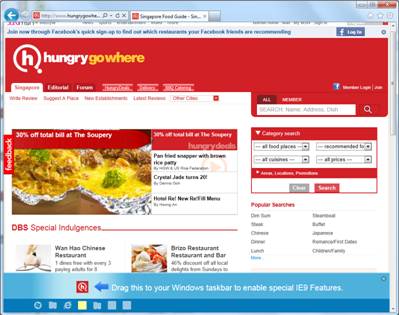
I'm going to compare HungryGoWhere to Yelp/Singapore. This is a sort of preview/teaser.


February 1, 2013

Product Strategy : Useful Astrology Apps

This happened about 15 years ago in Myanmar. This is also happening with many softwares today.

At that time, I had taken a 4-weeks course in Visual Basic, and another 4-weeks course in Visual C++. I had already rented a Windows PC at home.

I knew a bit of many kinds of astrology techniques, those kinds you can read in magazines and can master in a few minutes.

I was eager to code those astrology techniques into some GUI/desktop apps.

Before I started coding, I looked around. I read in some Myanmar magazines about some theses on astrology at our Computer University. Their calculations were thick,deep and complex. That's fine.

What was not so fine: their outputs were also very hard to understand.

I also checked out some Astrology CD's written by Myanmar programmers, selling at about K 400. Their outputs were of the same kind as those of the theses. (At that time Don Norman hasn't written Living with Complexity. He hasn't proclaimed that "Make output understandable.").

I couldn't learn from them, and so I coded my own design.

Front End

  1. 1 text box to enter user's question
  2. 1 button beneath it

Back End

  1. Read the user's question.
  2. Throw a 6-sided dice 6 times, since this is I Ching.
  3. Using the result from the dice throws, read from a table of answers.
  4. Show the answer to user.
I padded the answer with some folk psychology. I tested the app on my students, and I watched them discreetly from a distance.  At that time, "Usability Testing" was not even in my vocabulary.


My cost to create this was about 8 hours of coding and 8 hours of reading. And users liked it a bit.
Compare this to the other software makers' costs and the users' reaction to their softwares.

January 31, 2013

Cheap Innovation, Open Innovation, Research by Proxy

Open Innovation is a famous book, deservedly so.

And here is the story of The Double Helix. It's about how a young American -- 23 I think -- and a fellow British researcher, decoded DNA ahead of their rivals.

The young American was James Watson and the Brit was the 35 years old Francis Crick.

They were barred from doing their own experiments somehow. Anyway, they were behind their rivals in terms of data.

But they had a lot of experience in interpreting other people's data.

For instance, someone did an experiment, got some results, and published or presented his/her findings. Crick and Watson understood, or could explain the results better than the researcher who really undertook the experiment.


When you're lazy or late, you can often rely on their modus operandi.

January 21, 2013

UX Introspection: Will You Get Noticed in an Online Discussion?

Are you happy with all the online communities you have been to? What are your experiences? If you are a product designer, how would you improve or re-design such experiences?

The most frustrating experience, I assume, is when you have something of value to add to a discussion and yet, your voice, your contributions are drowned out amidst the din. You feel, "Nobody is listening." You feel you cannot catch up with the volume, the rhythm, the flow.

Online forums, discussions, conversations are not new shinny things any more. They have been in existence for decades. According to this Wiki entry, "Early web-based forums date back as far as 1994." And now we have dozens of such forums from  phpBB, vBulletin, myBB to SMF, Vanilla and bbPress.

If  a community is active and thriving, it is usually because of  the moderators, the elders, the statesmen,--- in other words, the people --- seldom because of the software.

I'm illustrating such a user experience below. Say this is Alberta, Canada, asking its provincial residents about their opinions of education. They all agreed in the end that the goals of a good education are : moral, entrepreneurial, and technological. Below, you can see that the wise Yoda's voice is as weighty as the voice of the whole province.

But will they hear it in this discussion? Will you also hear it? Will anyone even get the chance to hear it a few minutes after Yoda posted his comments?


1 Minute Later


Yoda Education students make moral, able to make a living easily, and fond of science and technology.

2 Minutes Later


Blah3 Obama?Yada yada yada. I love Romney. I love Ryan more. They will make the current economy crises go away.

Blah4 Obama had failed to create jobs. Though I love him still. The current economy crises will go away.

Blah3 I think good degrees get you good jobs. Given current economy crises. Huh

Blah2 Right, Blah1. what about humanities too? Plato, Shakespeare?

Blah1 what about religions? What about liberal arts?

Yoda I think education should make students moral, able to make a living easily, and fond of science and technology.

5 Minutes Later


Blah104 Blah blah blah is yses blah.Blah blah blah is yses blah
Blah105 Blah blah blah is yses blah.Blah blah blah is yses blah
Blah103 Blah blah blah is yses blah.Blah blah blah is yses blah

Blah102 Blah blah blah is yses blah.Blah blah blah is yses blah
Blah101 Blah blah blah is yses blah.Blah blah blah is yses blah
Blah3 Obama?Yada yada yada. I love Romney. Ilove Ryan more. They will make the current economy crises go away.
Blah4 Obama had failed to create jobs. Though I love him still. The current economy crises will go away.
Blah3 I think good degrees get you good jobs. Given current economy crises. Huh

Blah2 Right, Blah1. what about humanities too? Plato, Shakespeare?

Blah1 what about religions? What about liberal arts?

Yoda I think education should make students moral, able to make a living easily, and fond of science and technology.

10 Minutes Later


Blah104 Blah blah blah is yses blah.Blah blah blah is yses blah

Blah105 Blah blah blah is yses blah.Blah blah blah is yses blah

Blah1 what about religions? What about liberal arts?

Blah103 Blah blah blah is yses blah.Blah blah blah is yses blah

Blah1 what about religions? What about liberal arts?

Blah102 Blah blah blah is yses blah.Blah blah blah is yses blah

Blah101 Blah blah blah is yses blah.Blah blah blah is yses blah

Blah1 what about religions? What about liberal arts?

Blah1 what about religions? What about liberal arts?
Blah3 Obama?Yada yada yada. I love Romney. Ilove Ryan more. They will make the current economy crises go away.

Blah4 Obama had failed to create jobs. Though I love him still. The current economy crises will go away.

Blah3 I think good degrees get you good jobs. Given current economy crises. Huh

Blah2 Right, Blah1. what about humanities too? Plato, Shakespeare?

Blah1 what about religions? What about liberal arts?

View more comments/posts   <--- Yoda's wise insights buried here forever!

Yoda is no victim.


He won't complain, he won't suffer. He will just use his time more usefully, until our EthicMinds team designs a better discussion software.

Added: we solved this in  Product Strategy : Will You Get Noticed in an Online Discussion?

January 19, 2013

Product Strategy : Will You Get Noticed in an Online Discussion?

In a previous post, we described how bad contributions crowd out good ones and how good ideas get drowned under the overwhelming weight of bad ones. Here we're going to make some design suggestions for this problem. From the perspectives of both product strategy and user experience.

Just yesterday, we read Team Geek, by 2 famous Google engineers. When they were developing Subversion, they had a similar problem. In their email list, they found that just one participant was using up 70% of the core project contributors' responses. They concluded that their "energy and focus were being sucked away"(on page 98 of the book.) by this single participant.

They were discussing technical details of an open source version control system. The percentage of population who can and will join such a discussion, is severely limited. Imagine who and how many will join if we discuss such general topics like, "Goals of National Education," "Meaning of Life" etc.

Parkinson(of Parkinson Law's fame) had to say this: Whether to open a 5-million-dollar plant can be decided in 5 minutes. The decision as to whether to open a 500-dollar canteen or bicycle shack needs far, far more time, simply because there will be more participants.

Team Geek/Subversion's solutions:
1. email that person, asking him to stop
2. phone that person, asking him to stop

It was then, now is many years later. And they were not Forum business. Developers in Forum business can do better.

I am very encouraged by the following advances: Vanilla identifies bad people and keeps them out
and Gamification drives user reputation and abilities.

Our Solution 1


You're right if you decide not go full AI. Still you can use NLTK or other tool kits. You can word-count, check themes/sentiments behind forum posts, group/cluster posts similar in tone or content, and so on.

Our Solution 2


You can check who are posting most, most frequently. You can alert moderators or other users to check the quality of such participants' contributions.

You can stall or ban such participants.

Our Solution 3


At least, you can tweak your user interface to crowd some posts while elevating some posts at the same time, and you can do it randomly. Sigh.

January 18, 2013

Thinking Up New Products and Thesis Topics

on October 14,2011
  1. Steve Jobs once said that he's proud of products that he had done and maybe even prouder of products that he had chosen not to do yet.
  2. According to Bootstrapping Your Business: Start and Grow a Successful Company with Almost No Money, searching for business opportunities and great products is like mining: out of 10, you get 3, and out of those 3, you dig into 1.

  1. Is thinking up new products tough?
  2. Is thinking up thesis topics tough?

Thinking up thesis topics is(well, at least, was) easy.

Thinking up new products is even easier. Here's how:

  1. In academic world, if Student Number 138765 has registered to do "Abraham Lincoln's Logistical Problems in the American Civil War," the prof won't allow me to do that.

    In real world, after Friendster, MySpace, Facebook and Google+,(if I chose,) I am still free to do MyFriendsterSpaceBook+, right?

  2. In academic world, the devil is in the details.

    In real world, it is even more so. All Intuit founding team needed was the "47th mover's advantages." Then, Mint.com that Intuit bought out must have "57th mover's advantages."

Online banking, online teaching, social networking, job sites ... are all today's offerings 100% complete, perfect? All the necessary inventions have been done?

As Mr Henry Ford remarks, whatever you think is right.

Now, I am writing letters to Singapore software development companies, asking them to customize Moodle for independent private tutors.

Moodle is too good to be let go to waste. And it is easy to customize.

But then, the devil is in the details, and even more so in the software world.

January 15, 2013

Product Strategy : Every Thing Has Been Invented

Do not assume :
  1. A fellow Myanmar or Singaporean cannot invent
  2. Such inventions belong only to America, Europe or Japan.
  3. Everything has been invented.
Here's my stake on everything already being invented. Let's limit our discussion only to human beings' need to communicate.

The Mouth


I wish I were the one who invented the mouth. Every time you speak, make phone calls, shout, sing to your girl friend, make speeches, you will be paying license fees to me!

The Alphabet


I wish I were the one who invented the alpahbet. Every time you text with your phone, scribble your shopping list, email, type, you will be paying license fees to me!

The Hotmail, Yahoo Mail, Gmail, Facebook Mail


I missed them.

The QQ, Instant Messaging, The iPhone, The Twitter


I missed them.

The Flickr, Instagram, Pinterest


I missed them.

So, with all these inventions, are we now in communication heaven or Nirvana?

You can communicate anything you want to anyone you want anywhere in any manner you want, in any language or dialect, in any tone you want?

Language barrier has been broken? Culture barrier, generation gap barrier, all other barriers have been broken?

What about Jhonny Mnemonics and his brain dump techniques? What about how people communicated in ancient folk tales and myths?


Are we there already?

Product Development : the Right Balance of Cowardice

Should You Design a New Browser?


No, unless you are Microsoft, Google, Baidu, Tencent, Yahoo, Facebook, Amazon, Adobe, Oracle etc.

On the other hand, if you are at that level, why not?
If you're Samsung, you should invent even a  new programming language, such as Bada.

Should You Design a New Facebook or Amazon?


No, unless yours is a big country like China, India, Brazil or Indonesia.
But we have Facebook clones in China, Korea, Japan, and even in Vietnam, right?

Reasons Not to Design


There are many valid business reasons: high upfront costs, long payback period, very high breakeven points etc.

Also, if your new features are not essential, mission-critical to users, if they are not decisively better than the incumbents. eg. Facebook doesn't allow embedding images inside text in many places; your app may be able to enable this features; but this alone won't enable you to dislodge Facebook. But what if you can design a better, far better advertising platform than that of Facebook?

Yeah, there can be many more valid reasons.

I just don't want you to give up so easily, so early.

From my own personal experience, what I hate most is naysayers with unbalanced cowardice. Such people display a lot of symptoms described in books on panic/anxiety attacks. They bow down to their own emotions too easily and never bother to examine their beliefs and assumptions behind their feelings. Let alone refute those beliefs and assumptions, as Cognitive Behavioral Therapy would recommend.

Let's say, we are doing another Facebook. Instead of killing the idea outright, let's attack it semi-systemically or pseudo-systemically:
  1. At prototype level, that is easy, An example here.
  2. Do we have "killer" features, loads of them?
  3. Can we scale it?
  4. Can we promote it, market it?
Step 1: Many people don't know that even a single programmer/author can clone TinyURL, Twitter, Flickr, and Facebook for fun. That's exactly what Chang Sau Sheong did in his nice book  Cloning Internet Applications with Ruby. And he did so with a relatively new, immature, and adventerous technology!

Step 2: Let's assume you have such features in mind. e.g.a far better advertising platform as I mentioned above.

Step 3: How far do you need to scale in the first days/ weeks/months/years? Do you know that even Zuckerberg kept Facebook's growth in check in its early and not so early years so that it can grow in a more stable manner? And if you are earning well, won't that earning pay for the need to scale?How many dozens of data centers are you going to need?

Step 4:  What else can be better promotions than demos and centuries-tested word of mouth?

Be fearful, but be balanced.

The more your faith grows,
the more you let things flow,
the more you love, with them,
to flow.

January 11, 2013

Programming - The Answer , My Friend, is ...

on August 11, 2011

My Own Failures


1. I wrote an application in a Ruby web framework 1.x.x. Everything worked, fine. Then the 2.x.x. version came along and I upgraded and my app broke in many places. I fixed them somehow.

Then the 3.x.x. version came along and I upgraded and my app broke in many places again.

That is not the framework's problem. The real problem is I had used too many plugins.

2. I wrote an application in a PHP web framework 1.6.x. Everything worked, fine. Then the 1.7.x. version came along and I upgraded and my app broke in many places.

This is not the framework's problem. The real problem is I had used too many PEAR's.

3. Before all this, I worked for a project that migrated from EJB1 to 2 to 3 etc.
And for another project, where the project managers took years to move from Struts 1 to 2.

Other Failures


1. Netscape's spaghetti code that cost the company its battle against Microsoft.
2. Friendster's social graph that slowed the site to a crawl.
3. MySpace's "technical debt" that ruined the site.
4. Ruby on Rails framework --- Its lack of hosting (Maybe their developers don't care or it is their blind spot). And its handling of data management; if they don't know this part well enough, they should leave it alone e.g. PHP has no ORM and has been doing just fine.
5. Microsoft alone has a dozen or more data access technologies from 1998 to 2008, according to a book by Joel Spolsky. I don't have time or experience to know such stuffs.

My Own Successes


1. Porting RedBlack tree, AA tree etc from Java to Ruby is easy.
2. Porting shortest path, quick sort etc from Ruby to Python is easy.
3. Porting Regular expressions, string/text handling etc from PHP and Perl to Ruby is easy.
4. Porting higher order functions amongst Perl, Python, Ruby is easy.
5. Porting any plain domain or business object from any language to any other language is very very easy. From Java to Pascal, from Perl to PHP, from Ruby to C++, whatever.

6. Modeling or making mental representations or doing objects, classes and APIs for Law domains, Insurance domains, Education domains are very very very easy and fast.

7. Dreaming, going into trance, seeing in my mind eyes some apps end to end from the users' point of views is extremely easy and fast. "Easy" doesn't mean I do these activities well because, often, I even forgot to do them at all!

8. Writing domain objects is very easy.

9. Combining those objects is very easy.

Other Successes


1. Real programmers code everything by themselves. A paradox because they do and they don't.
2. Real programmers don't trust others' codes. A paradox because they do and they don't.

3. Excel team wrote even their own compiler, and killed off all dependencies.
4. Algorithms are very infrequent. They come once or twice in a decade.

5. Facebook is using many programming languages. So is Twitter.
6. Google founders didn't learn HTML etc on purpose.


The answer


If you can't find Apple-style appealing packaging, sell your stuffs, your wares raw, plain, uncovered!

Have fun!

January 10, 2013

Inventing the Medium and Digital Innovation

In Inventing the Medium, the author states that the digital medium is different from other media in possessing the four affordances:
  1. Procedural. The digital medium can execute conditional behaviors whereas other media cannot.
  2. Participatory. The digital medium can "script both sides of interaction so that each's actions become meaningful to the other side."
  3. Encyclopedic. The digital medium has huge memory storage like an encyclopedia.
  4. Spatial. The digital medium's space is virtual and navigable.
She goes on to match various disciplines to each affordance.
  1. procedural affordance with Computer Science
  2. participatory affordance with HCI(Human Computer Interaction)
  3. encyclopedic affordance with Information Science
  4. spatial affordance with Visual Design
Then she goes on to map each affordance to a well-known web application or service.
  1. procedural affordance with Google
  2. participatory affordance with Flickr
  3. encyclopedic affordance with Wiki
  4. spatial affordance with I-cannot-see-clearly-what
This is impressive, the only trouble is that I don't understand all this well.

For me, the digital medium

  1. can execute very complex instructions, steps, decisions etc. My chair, my doormat, even my TV cannot match this, not yet at least. (a) This is the ability to organize, mobilize, rally, orchestrate people at a distance. (b) This is the software agents' ability to decide on their own, or on behalf of other people or systems.(c) This is the robot's ability to sense its environment, to create it sown environment, to make sense of its environment etc.
  2. can store lots of data and can search, retrieve, sort, and rearrange this data very well. My dictionaries, my book shelves, my encyclopedias cannot match this right now.
  3. can represent space abstractly. My newspapers cannot grow larger and shrink smaller right now. Neither can my libraries, our football fields, or our local bazaars.
Will these 3 points, help me innovate in this medium better? You bet.

January 4, 2013

Should You Go for Totally New or Just Improve Existing Products?

Should you go for totally new or just improve existing products?

We need to be more careful whenever we use the word "new."

Whether the technology is new or old, doesn't even matter.

What matters is -- do the customers already feel the need? e.g. tooth decay is an old need and thus you don't need to educate the public about it. e.g. everyone wants to look good and thus you don't need to educate them about personal grooming etc.

In contrast, if you are designing accessories for iPhones, iPads etc, you may have to educate customers in some parts of the world on what these products are intended for. Or if you are running classes on creativity, innovation etc, many people may not realize that they need these skills or they may assume that they are already creative, innovative enough.

In this regard, you should even welcome competitors. The more, the merrier. Their very existence validates the market need you have assumed.

However, please bear in mind what Musashi has to say: "Have no preferred sword". Both introduce totally new products and improve existing products as well.

January 3, 2013

Digital Product Innovation,Academia,Grounded Innovation

Many people agree that Gorbachev as a professor can be cool but Gorbachev as a politician is disastrous.

Suppose I am a political science prof. I can invent a voting system such that
  1. age 5-10        1/2 vote per person
  2. age 11-20      1 vote per person
  3. age 21-30      2 vote per person
  4. age 31-40      3 vote per person
  5. age 41-50      4 vote per person
  6. age 51-above 1/2 vote per person
Yes, it's silly and impractical. But it will work in any classroom and in any academic journal. At least, it's "controversial," "radical," "innovative," "thought-provoking" etc.

Now, here comes a book on digital product innovation, Grounded Innovation Strategies for Creating Digital Products and the companion blog.

On Page 10, there are five properties that will be useful to explain digital products:
  1. Information Processing: computation e.g very early mainframes
  2. Interaction e.g. sketchpad, word processor
  3. Networking e.g. Internet PC/laptop
  4. Sensing e.g. Adidas, Nike
  5. Proactivity : Machine deciding for itself e.g. Smart phone
First of all are these properties to distinguish digital products from non-digital ones, or to distinguish one digital product from other digital products?

e.g. My pencil doesn't have "Information Processing" capacity, but my PC does. But my door knobs and door buttons do interact with us.

Then, if all digital products have " Information Processing" power, why include it in the list?

Then, "Proactivity"? A Tumbling Kelly toy always returns to its original position. Is it deciding this for itself? Doesn't any PC/laptop, smart phone, digital product decide for themselves to a degree?

We can keep on asking. But that's enough. We are not doing an academic exercise here.

We will discuss later another book on digital products, Inventing The Medium. An MIT book, but no better.


A Policy Game for Singapore

A Game from Silicon Valley


Please check out "Making Sense of the Games Politicians Play" in Bloomberg Businessweek, September3-9, 2012 issue, page-26-27.

Or this link or this link.

According to the Businessweek article, the computer game teaches the player about budgeting, trade-offs and compromise etc.

A Better Game to Come


We can design a better game, and we'll design it for free, too.

Here are lots of excellent programmers amongst Singapore's citizens, PRs, EPs etc. If even a handful of them feel any amount of love for this beautiful island, they will come and code the game.

Why this game is better:
  1. dilemma vs problem, problem vs wicked problem, either/or trap, "doing both"
  2. A quote I forget where I read first: "When given two bad options, good statesmen create better ones."
  3. Feynman's famous quote form Wiki: "Therefore psychologically we must keep all the theories in our heads, and every theoretical physicist who is any good knows six or seven different theoretical representations for exactly the same physics.
  4. Trade-offs is a fact of life, a fact of physics. We cannot yet wilfully teleport ourselves to another planet or another parallel( or otherwise) universe where we get more than 24 hours a day, not yet. Still, we need to reduce (1) the frequency/number of times we play and (2) the duration of the time we play trade-off game.

Why not an option-generation game?

The kind of game young (Mr) Sim Wong Hoo played (a poly grad , they told him, had no right to design a new sound card) ...

The kind of game young (Mr) Lee Kuan Yew played (a third-world country, they believed, must become a second-world country before becoming a first-world country).

December 25, 2012

New Software Product Development --- My Proofs - Part 1 of 100

A Hot Web Application

I happened to read a recent Life Hacker book and browsing its pages, found the following app.

Don't Break the Chain

The site describes the app as follows:


This is based upon a motivation technique purportedly used by Jerry Seinfeld. Read about it here. The Short Version:
  1. Pick a goal.
  2. Mark off the days on which you work toward that goal.
  3. Use your chain of marked off days as a motivator.


You can read more about its inspiration at Jerry Seinfeld’s Productivity Secret and at Don’t Break the Chain - Jerry Seinfeld's Method for Creative Success

There are apps for different platforms too:  IPhone App ,  IPhone and iPad apps .


My Intent

The fact is I've watched all the 9 seasons of Jerry Seinfeld for a couple of times. So has my son.

  1. I can get about 10 more apps from Seinfeld character.
  2. I can get about 10 more apps from George Costanza character.
  3. I can get about 10 more apps from Kramer character.
  4. I can get about 5 more apps from Elaine Benes character.
  5. I can get about 5 more apps from Newman character
  6. and so on.
Maybe my son has some more apps different from mine.

  1. And what about Charlie Chaplin?
  2. And what about Buster Keaton ?
  3. And what about Fatty Arbuckle?
  4. And what about Jim Carrey?
And for that matter:
  1. What about Clint Eastwood?
  2. And what about Kung Fu series?
  3. And what about Bond movies?
  4. And what about Jackie Chan?
  5. And what about ... ?
  6. And what about ... ?
  7. And what about ... ?
Such apps are small and therefore won't take too long to code.

If you have some time to spare, we want you to work with us.

Of course, we won't spend the rest of our life doing such small apps.

But before we do the next Google, the next Facebook, the next salesforce.com ... Insert any big and famous name here ... we want you to work with us.

December 24, 2012

User Experience and Product Development : Dreamer, Wisher Method --- Part 1

In a previous post, I have demonstrated how I am good at dreaming and my Walter Mitty- Dijkstra hybrid mode.

I think I am alright dreaming how a user would go through an imaginary application.

A few weeks back, I asked an online Singaporean programmers group to implement some features for an e-learning app. They responded saying my  feature cannot be "new." Then, I showed how "new" they could be, by asking this:


"OK. Find me something that looks like this.
  1. It's free and online. 
  2. I type main question, then choices, including if necessary, images too. And the answer.
  3. I can add as many question I like. 
  4. I can print it out, and it comes out nicely. 
  5. I can let my students practice there. 
  6. There can be tip/hints for students. 
  7. Answers are graded. 
  8. I can edit them. 
  9. I can download my question sets. They work offline too! 
  10. I can go on, but this should be enough.
This is 1 of 1000 things we can do for education/training etc. So I have no need to protect this. ... Please don't mention SCORM, IMS, Moodle, Atutor, Coursera, hot potatoes, whatever. If a nice thing is there, why would I code or ask others to code."

Yes, I have dreamed up dozens of apps. Each app can be divided up into dozen smaller apps.

Therefore, there is no need for me to protect, hide, hoard each micro/nano app.


I am willing share these dreams to willing hands and kindred spirits.

December 20, 2012

User Experience: How to Improve Singapore Press Holdings's Advertising Calculator

We're solving that problem today from the viewpoint of user experience. Since this is a tatical detail, we won't discuss product strategy at all in this post.

Task 1 : I want to calculate the cost of this ad in text-only format.


Task 2 : I want to calculate the cost of this ad in "customized text plus some pictures" format. It means that I 'll use some different fonts and typographical variations and that I'll add some images somewhere inside.


How The Calculator Works Now


Step 1 : Select the Advertisement Category


Step 2 : Select the Publication


Step 3 : Click on Calendar to select Publication Date(s)


Step 4 :Select the Advertisement Type


Step 5 : Select the Advertisement Size


Step 6 : See Results


Solution for Task 1


Here we should use a text box. User copies and pastes her text/copy into the box, and our software counts characters, words, lines, width and height of the whole text/paragraph. Then, we gives estimate costs to user.

Solution for Task 2


Here, we should allow user to upload her ad copy as an image as in Facebook, Flickr etc. Then, our software will calculate its width, height and the estimate costs.

Basic image sizing, re-sizing are familiar to most programmers --- Imagick, Rmagick, PIL(Python Image Library), many PHP libraries and frameworks.

Humility


We know it takes many persons to change a light bulb at a company at Microsoft's level. You have many users so you must take extra special care not to break anything by your fix/enhancement.

I point this out just as an exercise and a reminder for future developments.

And I do notice that SPH has many other mechanisms and procedures to handle these problems very satisfactorily e.g. staffs at ads section can do this calculation for you. Maybe more cool alternatives that I may still be unaware of.

Product Development Exercise: Singapore Press Holdings Ad-cost Calculator

Underlying Principle


Tom Peters has suggested that we hone our design skills and design sensibilities by going shopping for under $10 and by learning do's and dont's from the things we've bought. Later, we'll refer to this as $10-design-learning activity.

Today Lesson


Today, we are going to learn from Singapore Press Holdings Ad-cost Calculator. Your task is to calculate cost for the following ad:

                          World Class

 As a software company,
    Do you want
    --- new product ideas?
    --- delightful user experience?
    --- outside developers grateful for your platform/APIs well-designed?
    --- a new leash of life for your current products?

                   More details at EthicMinds blog.

 Kyaw Kyaw Naing/ George
 B.A.(Hons, First Class), M.A., M.Comp.(Computing)
 time.proven.works@gmail.com


Tasks Hidden in Sub-Layers


I repeat: "Your task is to calculate cost for the following ad." This is not a straightforward task; nothing seldom is in web apps world.

To calculate the cost, you need to be clear about

  1.   What category of ad you are placing (Well done, the site handles this excellently.)
  2. In which paper (Well done, the site handles this excellently.)
  3. What Publication Date(s) (Well done, the site handles this excellently.)
  4. What Advertisement Type (Well done, the site handles this excellently.) That is, Run-On, Semi-Display, or Display.
  5. What size you want (Well, is this done?)

Solutions from My Weaknesses


Once a friend asked me in the 80s: "Do you know some martial arts?"
Me: "I 've studied 7 martial arts in 7 days each."
My friend, being a very smart person, stopped asking about martial arts.

Now, I know programming the way I know Wing Chun, Brazilian Jujitsu, Krav Marga, Kung Fu, Karate, Judo, Muay Thai, Bando, Kendo, Kempo, Cilat, Akido etc.

This calls for a WYSIWYG/visual editor,such as CKEDIT/TinyMce, or some other in-house versions, like the ones Facebook and Google are using.

Personally, I've seen it implemented in a Javascript book I read in Jurong East library, a red cover, published 3 or 4 years ago.

Personally, I've tested TinyMce with Ruby on Rails, PHP(codeIgniter) and Python(Django). I believe it will be fine with Perl, ASP.NET or Strut/Spring/plain JSP too.

Solutions from My Non-Weaknesses


I'm closing my eyes to see and inducing myself into what I call Walter Mitty- Dijkstra hybrid mode.

Dreaming wildly but not so in the clouds as an astronaut architect. ("The hallmark of an architecture astronaut is that they don't solve an actual problem... they solve something that appears to be the template of a lot of problems. Or at least, they try.") Dijkstra, on the other hand, always remembers that humans(he included) have small heads.

What do I see in my dream?

What do you see in your dream? What use cases, what user stories, what scenarios, what happy paths, what unhappy paths, what fault trees ?

What do I see in my dream? 
(Note: The following is written in dream-speak.)


There is a box where I can type in, what they call "text editor" in HTML.

There, I copy my ad's copy and paste it there. I can place a few images among the text as well. It can be drag and drop. Or I upload some images. Or I can choose images from a given list somewhere alongside the box. ....

When I finish arrangement, I click a button named something like "Preview." And I see my ad amongst some other typical-looking ads.

There I see how my ad will look like: Is it noticeable? Does it look cluttered? Too small? Too narrow or broad? Or is it too expensive? I close the Preview page and change my ad again: more words or fewer words, more pictures or fewer. bigger fonts or smaller.

  Do I need a border, a thick one or thin, a plain one or colored?2x3cm pic or 3x2 cm?

Edit -> Preview-> Re-edit ... till Save cycle goes on


After a few minutes, anyone can formalize this dream into a spec. (If you still need more help, email me for FREE help.)


Added : We solved this UX problem in a later post.

A Tip for Job Search: Gold Rush Skills

  If you need to make some money very quickly, what would you do? Your answer points to the kind of problems you can solve. They give you so...